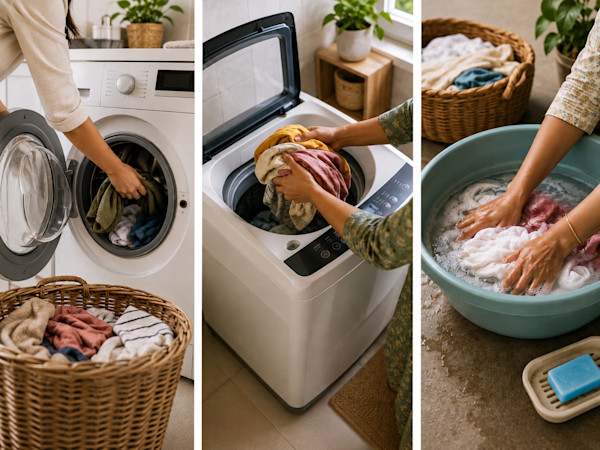
Front loaders, top loaders, and hand washing clean clothes in different ways, so they do not all need the same detergent. A front loader uses little water and a gentle tumble. A top loader fills a full drum and moves clothes with a strong agitator. Hand washing depends on a good soak and your own effort. Match the detergent to how you wash, and you get the full clean you paid for. Here is the short answer, then the reasoning.
Which detergent should you use — the short answer
Your wash | Use this Surf Excel format | Why |
|---|---|---|
Front-load machine | Matic Front Load liquid | Dissolves fast and makes little foam, so the tumble still works. |
Top-load machine | Matic Top Load liquid | Works effectively even in a full drum of water and higher dilution of detergent. |
Hand wash/semi-automatic | Quick Wash powder | Built to loosen tough stains in soaking for easy removal |
Short or rushed cycle | Surf Excel Matic Liquid | The liquid dissolves at once, so it still cleans clothes in a short cycle. |
The quick version
- ✦
Different machines, different detergents: Front load, top load, and hand wash each clean clothes in their own way.
- ✦
Chemistry is the one lever you control: You cannot change the machine, so start with the detergent.
- ✦
The wrong format wastes cleaning power: A front-load formula in a top loader, or a high-foam powder in a front loader, cleans less.
- ✦
More detergent does not mean more clean: Too much detergent just creates foam and leaves residue.
How front load, top load, and hand washing differ
Every wash uses the same four things: time, action (scrubbing or tumbling), chemistry (detergent), and temperature. Each method just uses a different mix, which is why one detergent cannot suit them all.
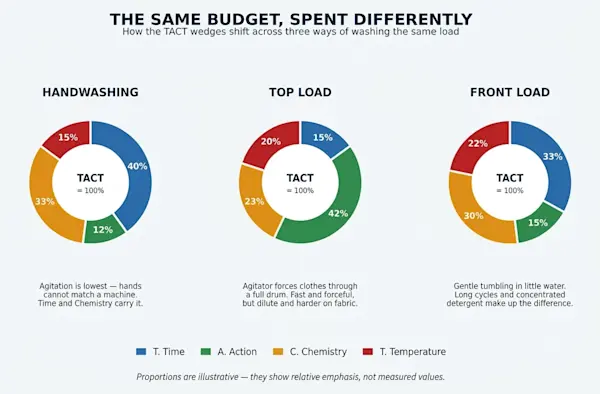
Wash type | Water & detergent | Action | Typical cycle | Cleaning leans on |
|---|---|---|---|---|
Hand wash | Generous dose, warm at most (35–40°C) | Lowest | 20-min soak, then rubbing | Time + Chemistry |
Top load | High water, dilute solution | Highest | 30–50 minutes | Action |
Front load | Low water, concentrated | Gentle | 60–120 minutes | Time + Chemistry + Temperature |
In short: hand washing is slow and gentle and leans on the detergent. Top loading is fast and forceful but watered down. Front loading is slow, gentle and more concentrated. None is better overall; each spends the same budget differently. The detergent is the part you control, so start there.
Front-load machines: which detergent and why
Front-load machines tumble clothes through a shallow pool of water instead of a full drum. Two things follow. With less water, the detergent is more concentrated and does more of the work. But too much foam is also a problem because it cushions the drum and softens the tumble, so front-load machines need a low-foam detergent.
Use Surf Excel Matic Front Load liquid: It dissolves at once and makes little foam. Front-load cycles also run long, often 60 to 120 minutes, because the extra time and heat make up for the gentle tumble.
Top-load machines: which detergent and why
Top-load machines use a central agitator that pushes clothes through a full drum with real force. That force allows for shorter cycles, often 30 to 50 minutes, but the extra water dilutes the detergent, so it does a little less work.
Use Surf Excel Matic Top Load liquid: It acts quickly at diluted concentrations. The trade-off is more water used and more wear on clothes.
Hand washing: which detergent and why
Many people still rely on hand washing, so the approach matters. Your hands or a simple tub give far less scrubbing than an automatic drum, and the water is only as warm as your hands can take, about 35 to 40°C. So the soak and the detergent do the work.
Use Surf Excel Quick Wash powder: It is built to loosen tough stains in soaking itself and lifts soil with less scrubbing. Tip: Soak heavily soiled clothes for about 20 to 30 minutes before you rub them.
Short or rushed cycles
Sometimes there is no time: a quick wash before work, or a uniform needed by morning. A short cycle mainly cuts one thing: time.
Use Surf Excel Matic Liquid: As a liquid, it dissolves as soon as it mixes with water, so a short wash still cleans clothes well. When you are short on time, a fast-dissolving detergent is the simplest way to make up for it.
Why the wrong detergent format costs you cleaning power
A detergent made for one kind of wash does less in another. Put a front-load formula in a top loader, or a high-foam powder in a front loader, and the cleaning drops.
- ✦
In a front loader, a high-foam detergent makes foam that cushions the drum and weakens the tumble.
- ✦
In a top loader, the wrong detergent gets watered down and gives poor cleaning results.
- ✦
In a hand wash, a detergent that needs a machine to work leaves you scrubbing harder.
The fix costs nothing: match the detergent to the machine and technique.
The science behind it: Sinner's Circle and the TACT model
There is a name for why this works. In 1959, a chemist at Henkel called Herbert Sinner set out a simple rule: every wash uses four things (time, action, chemistry and temperature) and together they always add up to 100%. Cut one and another has to grow to keep the same result.
The detergent is the one part you control every wash, so it is the easiest lever to pull.
Read the full explainer: Sinner's Circle and the TACT model
