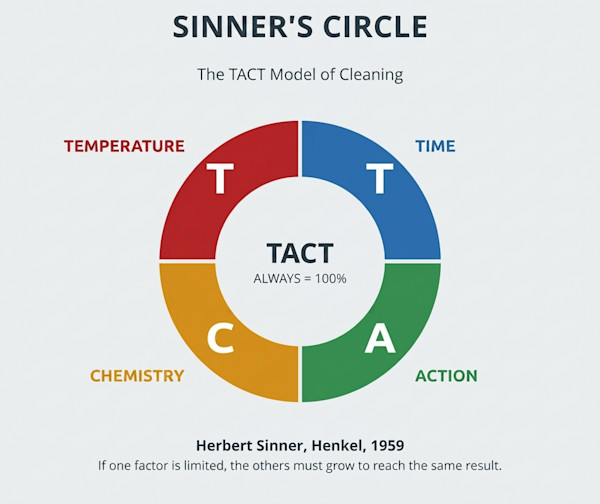
In 1959, a chemist at Henkel named Herbert Sinner set out a simple idea that still holds: every wash depends on four things, and together they always add up to 100%. Cut one, and you have to raise another to get the same result. It is still how detergents are made and how wash cycles are designed today.
The four factors are easy to remember as TACT: Time, Action, Chemistry and Temperature. They are usually drawn as four slices of one circle, each growing only if another shrinks.
In Summary:
- ✦
Every wash uses four things that add up to 100%: Time, Action, Chemistry and Temperature. Cut one and another must grow.
- ✦
Time: the cheapest to add; it uses almost no energy.
- ✦
Action: the scrubbing or tumbling; limited by what the fabric can take.
- ✦
Chemistry: the detergent; the one part you control every wash.
- ✦
Temperature: speeds things up, but uses the most energy and can set some stains.
- ✦
At Surf Excel, we call it the same budget, spent differently: find what your wash is short on, then raise another to make up for it, usually the detergent, since it is the easiest to change.: find what your wash is short on, then raise another to make up for it, usually the detergent, since it is the easiest to change.
The four factors at a glance
Factor | What it is | Key constraint | Your control |
|---|---|---|---|
Time | How long the wash runs | Cheapest to increase; costs almost no energy | High |
Action | Mechanical energy applied to fabric | Limited by what the textile can tolerate | Medium |
Chemistry | Detergent: surfactants, enzymes, builders | The factor you control every single wash | High |
Temperature | Heat driving reaction rates | Largest energy cost; can set protein stains | Medium |
T — Time
Time lets everything else work. The detergent needs a few minutes, not seconds, to soak in and lift the dirt. Time is also the cheapest thing to add, since it uses almost no energy, which is why the eco cycle is usually the longest. When time is short, a fast-dissolving detergent such as Surf Excel Matic Liquid helps make up for it.
A — Action
Action is the physical effort: the tumble of a drum, the push of an agitator, or your own scrubbing. It knocks loose the dirt the detergent has already loosened, and keeps fresh detergent reaching the cloth. How much you can use depends on the fabric. Wool, silk and delicate synthetics cannot take much, so their cycles run longer instead, letting time stand in for action.
C — Chemistry
This is the detergent's job, and it has three main parts working together: ingredients that lift grease and hold it in the water, enzymes that break down everyday stains like food, and water softeners so the rest is not wasted fighting hard water. Chemistry has improved the most over the years, which is why cold water washing works today. It is also where a brand earns its place: Surf Excel makes a different format for each kind of wash, so the cleaning power stays where you need it.
T — Temperature
Heat speeds up cleaning and helps shift grease. As a rough rule, every 10°C increase in temperature makes the cleaning work about twice as fast, so a 60°C wash cleans quicker than a 30°C one. But heat has limits. It uses the most energy and can set stains like blood and egg. Extremely hot water can stop the enzymes from working. Detergents such as Surf Excel are built to work at everyday temperatures, which is what makes a cooler, cheaper wash possible.
Putting it to work: choosing a detergent
Of the four, chemistry is the one you fully control every wash. You cannot easily change how the machine moves, and the cycle mostly fixes time and temperature. But you do choose the detergent, and picking one made for your wash is the simplest way to use Sinner's Circle at home. A detergent made for one kind of wash does less in another, so matching the format to the machine keeps the chemistry doing its full share.
For the full product-by-machine guide, see: Which detergent should you use for a front load or top load machine?
Where the model strains
Sinner's Circle is a rule of thumb, not a formula. The four are not perfectly swappable: no amount of time removes a stain that needs the right enzyme, and no amount of detergent replaces the scrubbing needed to shift stuck-on dirt.
Some people add a fifth factor, water quality, arguing that hard water deserves its own slice rather than being counted under chemistry.
It also says nothing about order, which matters: heat a protein stain before the enzymes have worked, and you can set it for good.
Even so, as a simple way to think about cleaning anything, TACT is hard to beat. Work out what you are short on, then add more of something else.
