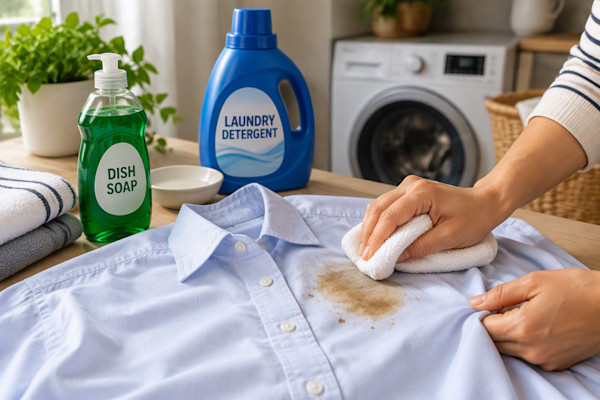
Dish soap can be used on clothes, as long as it stays a spot treatment. The same grease-cutting power that clears last night’s kadhai can loosen a fresh oil stain on your favourite shirt. The catch? It’s made for dishes, not fabric. Use a single drop, rinse it out completely, and finish with a proper wash in laundry detergent. And never pour it into the washing machine.
The rest of your cleaning cupboard is a different story. Ammonia, oven cleaner and heavy degreasers can damage fabric, and some are unsafe to use on clothes at all. So before you reach for whatever’s under the sink, it helps to know what’s safe and what isn’t. For reliable grease stain removal, the laundry detergent you already own does the job best, because it’s designed for clothes.
Grease stain removal, step by step
- 1
Blot the excess. Press a paper towel or clean cloth onto the oil to lift what’s pooled on the surface. Don’t rub, or you’ll spread it.
- 2
Test on a hidden seam. Whatever you use, check it on an inside hem first, so you know the dye won’t move.
- 3
Pre-treat the stain. The simplest option is a liquid laundry detergent. With Surf Excel Matic Top Load Liquid or Surf Excel Matic Front Load Liquid Detergent, apply directly to the stain, rub gently and wait 10–15 minutes. If you’re using dish soap instead, a single drop of a clear one is enough. Cover the whole oily area, including the halo around the mark.
- 4
Rinse from the back with cool water. Flushing through the reverse side pushes the oil out the way it came in. Rinse dish soap out completely, as leftover soap attracts dirt.
- 5
Wash with laundry detergent.Extension guidance for grease and oil stains is to pre-treat, then launder in the hottest water safe for the fabric. Check the care label first.
- 6
Check before any heat. Look at the garment while it’s damp. If a mark remains, repeat steps 3 to 5 before drying or ironing, because heat makes leftover oil much harder to remove.
Which Surf Excel detergent finishes the job?
Dish soap can loosen grease, but the wash itself needs a laundry detergent. Choose the one that matches how you wash.
For machine washing: Surf Excel Matic Top Load Liquid or Surf Excel Matic Front Load Liquid Detergent
Use Surf Excel Matic Top Load Liquid for top-load fully automatic and semi-automatic machines, and Surf Excel Matic Front Load Liquid Detergent for front-load machines. Both have a multi-surfactant system that provides robust oily and particulate soil removal by helping the wash liquor break down greasy soils and detach stains from fabric. Both can also be used for pre-treatment: apply directly, rub gently, wait 10–15 minutes, then wash, and repeat if needed.
Dose: 1 cap (approx. 60 g) for a regular load; 1½ cap (approx. 90 g) for a large or heavily soiled load.
For hand washing or a semi-automatic machine: Surf Excel Easy Wash Detergent Powder or Surf Excel Quick Wash Detergent Powder
Both powders have a high-active surfactant system for robust oily and particulate soil removal, and both support soaking-based tough stain removal with lesser effort. Surf Excel Easy Wash Detergent Powder’s multi-enzyme system also supports removal of food stains containing proteins, starches, tough fat and gum. Follow the pack instructions for soaking.
Dose: hand wash, approx. 30 g regular, 45 g heavily soiled; semi-auto, approx. 45 g regular, 60 g heavily soiled.
For convenient machine dosing: Surf Excel Matic Smart Shots
Surf Excel Matic Smart Shots are concentrated unit-dose capsules for all machines, including top-load fully automatic and front-load machines. They deliver 3-in-1 benefits: stain removal, long-lasting fragrance and fabric care. Place the shot in the drum; never cut, pierce or apply a capsule directly to a stain.
Dose: 1 shot for a regular load; 2 shots for a heavy load.
What are the best household cleaners for oily and greasy stains?
Not everything under the sink belongs near your wardrobe. Here’s what’s safe on fabric, and what isn’t.
Cleaner | Safe for clothes? | Notes |
Liquid laundry detergent | Yes | Designed for fabric; apply directly as a pre-treatment, then wash as directed |
Clear dish soap | Yes, for spot treatment only | Use a drop, rinse out completely, and never put it in the washing machine |
White vinegar | Yes, but not for grease | Useful for odour, but it won’t break down oil |
Chlorine bleach | Caution | Only on fabrics whose label allows it.Never mix bleach with ammonia or acids, as this releases toxic gases |
Ammonia-based cleaners | No | Not designed for fabric, and dangerous if they meet bleach |
Oven cleaner and heavy degreasers | No | Too harsh for fabric fibres and dyes |
Petroleum solvents | No | Can leave an oily, flammable residue that is hard to wash out |
The safest pre-treatment for most oily stains is the laundry detergent you already use. Clear dish soap is a backup when that isn’t to hand.
Can I use dish soap on clothes?
In small amounts, yes. Dish soap is made to cut grease on cookware, and its surfactants work the same way on fabric. They surround oil, lift it from the fibres and hold it in the water so it rinses out. That’s why a drop of dish soap on an oil stain on clothes can loosen cooking oil, butter, salad dressing and the body oil that builds up on collars and cuffs.
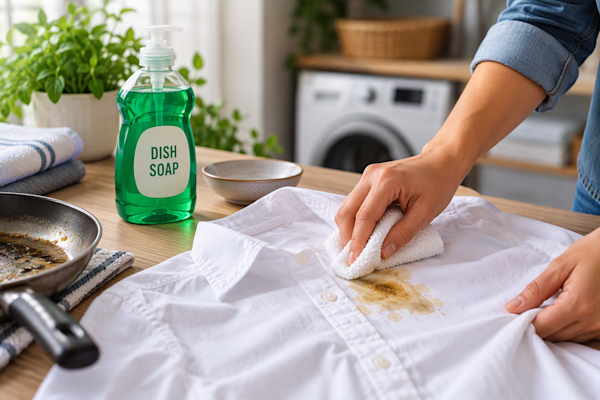
It does have limits:
- ✦
It’s a pre-treatment, not a wash. It’s made for dishes, so finish with a laundry detergent.
- ✦
Keep it out of the machine. Dishwashing liquid isn’t made for washing machines and can produce far more suds than the machine is designed to handle.
- ✦
Choose a clear one. Coloured or moisturising versions can leave dyes or residue on fabric.
- ✦
Rinse it out completely. Leftover soap attracts dirt.
When the stain is dried or set in
Dried oil has bonded more firmly with the fibres, so it needs softening first.
- 1
Rehydrate the stain. Dampen the area with warm water, or soak the garment in warm water for a while.
- 2
Pre-treat the whole area. Apply Surf Excel Matic Top Load Liquid or Surf Excel Matic Front Load Liquid Detergent directly, rub gently and wait 10–15 minutes. For hand washing, soak in a Surf Excel Easy Wash Detergent Powder solution as directed on the pack.
- 3
Wash in the warmest water the fabric allows.
- 4
Repeat if needed. For heavy grease,a second treatment may be necessary. Air-dry between rounds.
Fabric considerations for oily stain removal
Fabric | Safe approach | Caution |
Cotton | Liquid detergent pre-treatment, warm wash | High heat can shrink some cotton; check the label |
Polyester and synthetics | Liquid detergent pre-treatment, cool-to-warm wash | Avoid very hot water |
Wool | A mild detergent made for wool; blot, don’t rub | Dry flat; harsh treatment damages fibres |
Silk | Professional cleaning recommended | Risk of water spotting; test a hidden area first |
Coloured fabrics | Test colourfastness first | Some dyes bleed under concentrated cleaners |
Always test any product, dish soap included, on a hidden seam before treating a visible stain.
Common mistakes that make oily stains worse
- ✦
Rubbing the stain spreads oil sideways into clean fabric.
- ✦
Using hot water too early can set some oily stains. Start with cool water for the first rinse.
- ✦
Skipping the halo. The oil spreads further than the darkest part, so treat the whole area.
- ✦
Machine-drying before checking makes any remaining oil much harder to remove. Air-dry and inspect first.
- ✦
Using too much dish soap leaves residue that attracts dirt. A drop is enough.
- ✦
Putting dish soap in the washing machine. Use laundry detergent for the wash.
Conclusion
Dish soap can rescue a fresh oil stain, but it’s a quick fix, not a wash. For dependable grease stain removal, pre-treat the whole oily area, rinse from the back, wash with a laundry detergent in the warmest water the care label allows, and check before any heat. Keep harsh household cleaners away from your clothes, and never mix bleach with ammonia.
Frequently asked questions
Can I use dish soap on clothes? Yes, as a small spot treatment on washable fabrics. Use a drop of clear dish soap, rinse it out completely, then wash with laundry detergent. Never put dish soap in the washing machine.
Does dish soap remove grease stains from clothes? It can loosen fresh grease, because its surfactants surround oil and lift it from fabric. Treat it as a pre-treatment, then wash with laundry detergent in the warmest water the fabric allows.
Is it safe to use dish soap on coloured clothes? Usually, in small amounts, but test it on a hidden seam first, as some dyes are sensitive to concentrated cleaners. Use a clear version without added dyes, and rinse thoroughly before washing.
Can you remove an oily stain after clothes have been through the dryer? It’s harder, but sometimes possible. Rehydrate the stain with warm water, pre-treat the whole area, and wash again. You may need more than one round, and some heat-set stains may not come out fully.
What household items should you never use on clothes? Avoid ammonia-based cleaners, oven cleaners, heavy-duty degreasers and petroleum solvents. Use chlorine bleach only where the care label allows it, and never mix bleach with ammonia or acids.
Is laundry detergent better than dish soap for oily stains? For clothes, yes. Laundry detergent is designed for fabric and for the wash cycle. Surf Excel Matic Top Load Liquid and Surf Excel Matic Front Load Liquid Detergent can also be applied directly to the stain before a machine wash, so you don’t need a separate product.
